




UpTime Industries - Compute Blade TPM V1.0 - Kickstarter Edition
Scalable ARM Blade Server - Enterprise-level device for everyone: Designed to work 24/7. Developed by listening to and understanding the desires of real users. By a real user. Tested in a real production environment. And the CPU is overclocked!
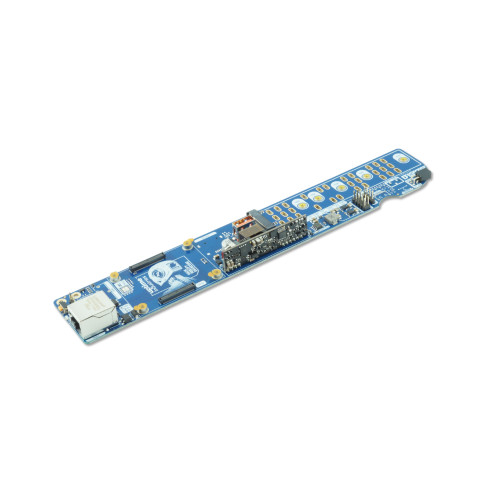
The device is a rack-mountable, PoE-powered carrier board for Raspberry Pi Compute Module 4 and compatible devices with all the necessary interfaces. With Compute Blade, you can create a high-density, low-power-consuming, plug-and-play blade server for home or data-center use.
Features
- Raspberry Pi CM4 support
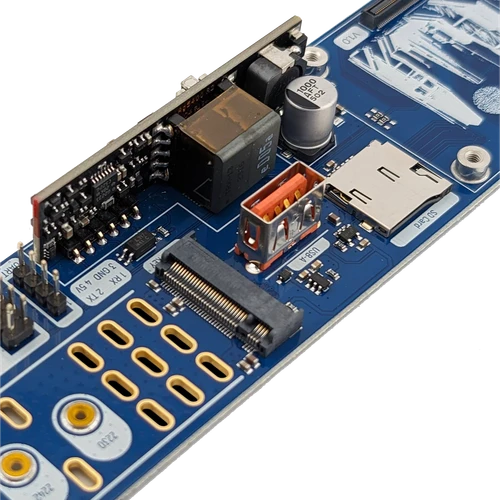
- NVMe SSD up to 22110 (2230, 2242, 2260, 2280 supported)
- Gigabit Ethernet
- Power over Ethernet IEEE 802.3at (PoE+) up to 30W (normal operation 2-8W)
- Raspberry Pi CM4 by PoE 5.1V power supply, which has improved stability under overclocking.
- USB-A for a flash drive for copying data during setup with UART or YubiKey keys during operation.
- UART0 on the front (TX, RX, GND)
- Additional UART0 with 5v in (or out) next to module port
- Two digital RGB LEDs
- Activity, Power, and SSD LEDs
- TPM 2.0 onboard
- PWM fan connector for the custom backplane (Fan Units), supports UART communication.
- Programmable button on the front panel
- IEEE 802.3at detection (on Raspberry Pi with GPIO pin and additional LED on the blade
- Fixed WiFi, Bluetooth, and USB boot (nRPIBOOT) settings, with no hardware switches, for a locked-down, tamper-resistant node
- Toggleable front LEDs that can be turned off
Various optional modules supported
- Optional real-time clock (RTC) module
- Various enclosure options, suitable for home and office, from small to data centers.
- Unique Fan Unit
Insights
For maximum security, you can use the onboard TPM 2.0 chip*, or optionally install hardware encryption keys such as the Yubico YubiHSM 2 or Yubico YubiKey 5 Nano.
There is the possibility to install RTC so that the device does not need to reset the clock after a complete shutdown (this may be necessary to connect the "blades" to your cluster).
The main difference from a conventional blade server is that there is no single point of failure in the form of a server platform. Yes, the PoE network switch remains, but it is also required for the blade server. Replacing a switch or having a spare one is much easier than having another server platform. And usually, the reliability of network equipment is very high.
In case of blade failure, you can simply disconnect it from the switch and remove the failed blade from the chassis. Rebooting/Power-Cycling a single blade can easily be accomplished by disabling power for its switch port for a moment.
The CM4's integrated network boot capability allows for easy re-provisioning and rescue systems. The single blade is lightweight, has no moving parts, and can be shipped without special requirements.
(Secure boot requires additional configuration)